In 1940, the first of Universal’s five Mummy sequels largely ignored the events of the previous film to kick off a new plotline that would carry on through a raft of follow-ups before ending when a variation of it crossed paths with Abbott and Costello in 1955.
In 1990, Witchcraft 2: The Temptress was the unlikely progenitor of a similar and ultimately far more ambitious scheme – something that would become arguably horror’s longest-running franchise at a whopping seventeen movies and counting.
Is Witchcraft in fact the longest-running horror franchise? As always, it depends upon how (and what) you count. Godzilla obviously has it beat in both temporal longevity and total number of installments, with nearly forty films (and counting) between 1954 and the present day.
But those flicks are divided into various eras, which often reboot the franchise from one to the next – and Godzilla movies are at the ragged edge of what most people would consider “horror” anyway.
Full Moon’s Puppet Master series is a closer analogue, with fifteen films between 1989 and today, among them a couple of spin-offs, a crossover, and a reboot. Nothing else really comes close, though, and certainly not without rebooting or restarting the franchise at least once or twice along the way.
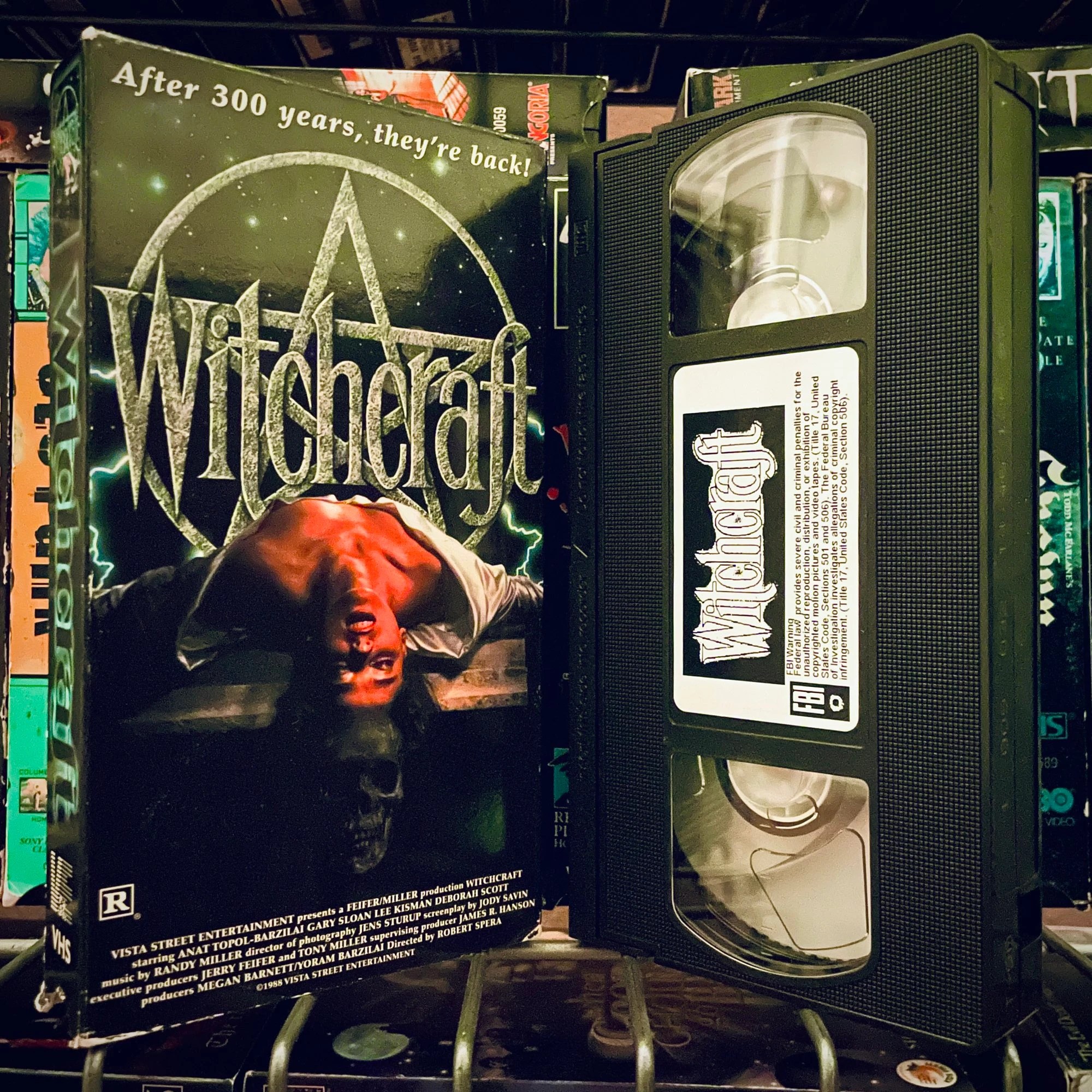
So, how did Witchcraft get here? From 1988, the first film in the series is a sedate but mostly adequate riff on the Rosemary’s Baby formula, in which a new mother’s husband turns out to be the reincarnation of a three-hundred-year-old warlock who has designs on their baby.
Starting with the aforementioned Witchcraft 2, however, the franchise decides to pick up with the baby from the first movie, now grown into possibly the oldest-looking teenager in cinematic history. Adopted by more normal parents, he lives a normal life for an old-looking teenager, until his neighbor, a blonde Elvira type, decides to try luring him back to his witchy roots in a flick that is basically a supernatural slasher with more seduction scenes.
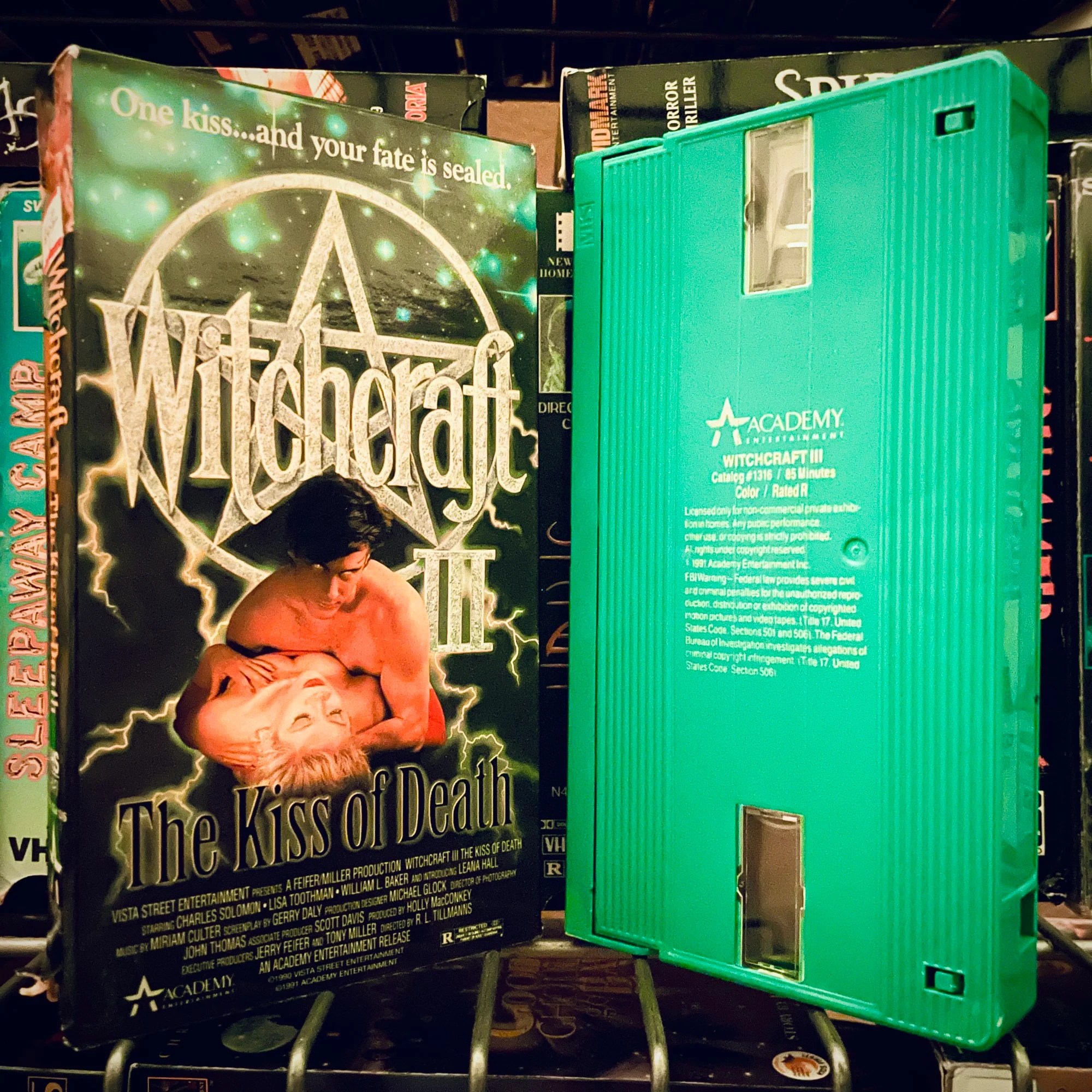
To the extent that this series has a formula, it will be firmly entrenched by 1991’s Witchcraft 3: The Kiss of Death, which continues to follow the adventures of the baby from the first movie, now an adult who has become an absolutely terrible lawyer, an occupation he will continue to hold (though seldom practice) for the remainder of the franchise.
His name has also changed a few times along the way. In the first movie, he is either named William Stocton or William Churchill, depending on who you believe, and in the second he has taken the name William Adams. By part three, he is somewhat inexplicably named Will Spanner – a name he’ll keep from here on out.
Will is ultimately what makes the Witchcraft series such an odd duck. With the exception of a couple of pointless cul-de-sacs, virtually every one of its seventeen installments (as of 2025) follows the adventures of our “white warlock” cum sad sack attorney, played by a revolving host of some of the least charismatic actors you can possibly imagine.
On social media, I explained the franchise as being “kind of like if Skinemax made a series like Forever Knight or Highlander, but all the episodes were feature length, cost a nickel, and were of wildly varying quality (so long as that variation never got all the way to ‘good’).” I think that’s a pretty solid summary.
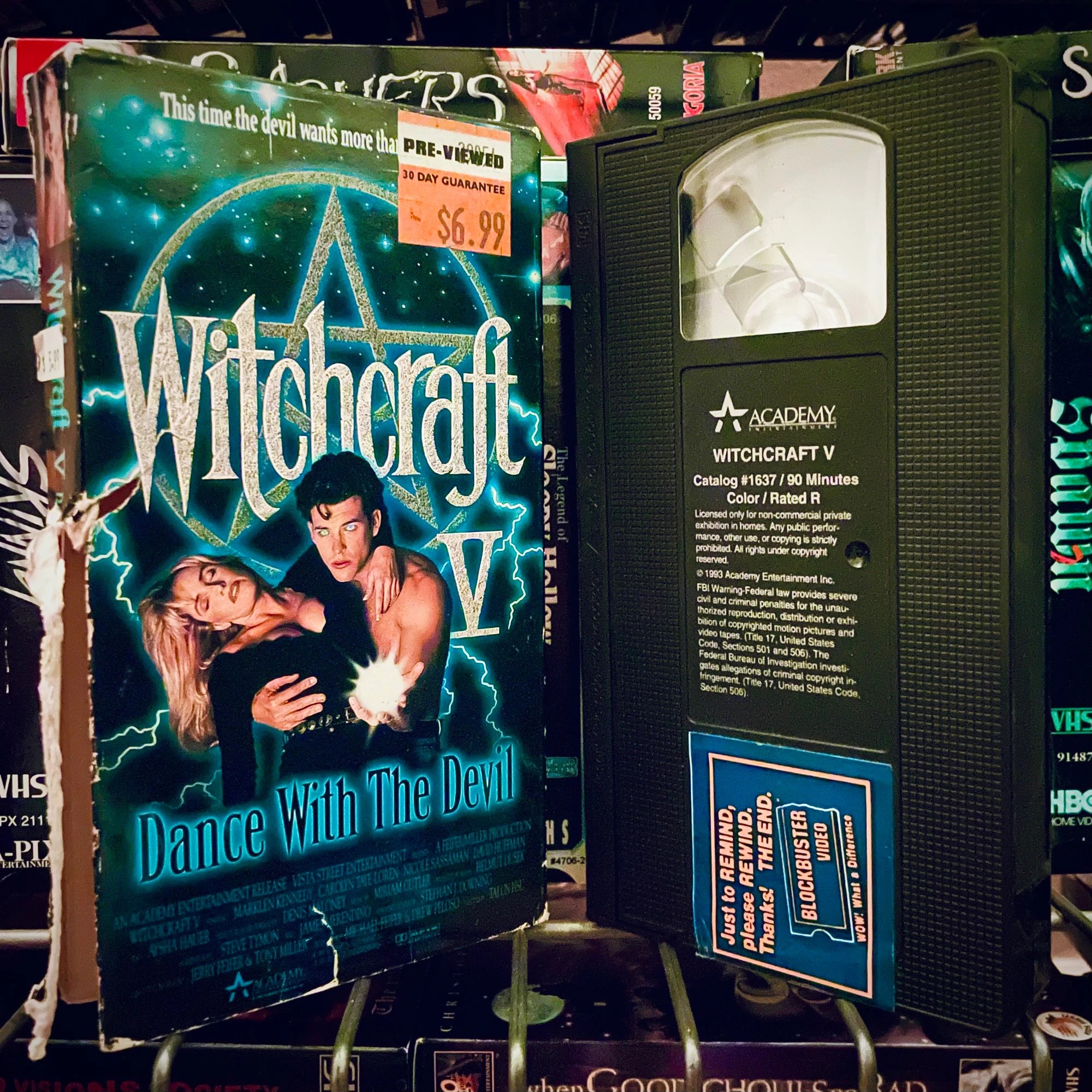
“I have never actually watched any of these because I assumed they were basically soft-core with more plot,” wrote one user on Bluesky when I announced my intention to mainline the first eleven Witchcraft movies in one soul-destroying, fifteen-hour marathon. It’s a common refrain, and one that was largely also true of me, before I undertook this particular fool’s errand.
It’s also not inaccurate, and it becomes more and more true the longer the franchise wears on. The seventh installment features some of the longest, oddest sex scenes I’ve ever witnessed, while the tenth film in the series devotes fully a third of its runtime to sex scenes and pointless nudity.
The “more plot” is sometimes debatable, as well. It would have been easy enough for a franchise whose main selling point seems to be (negligable) sex appeal to simply repurpose a raft of spec scripts into vaguely supernatural erotic thrillers, but the Witchcraft series goes the extra mile of shoehorning Will Spanner into every installment, even though his own supernatural powers and origins rarely play into the plot.
Despite the presence of Will and, later, a couple of other recurring characters, pretty much none of the movies have anything to do with one another, with the exception of occasionally reusing footage from part one. Will is engaged to a seemingly endless stream of women, each one replaced without explanation in the next film. Even when he does settle down with one fiancée for several movies in a row, she is played by a different actress each time.
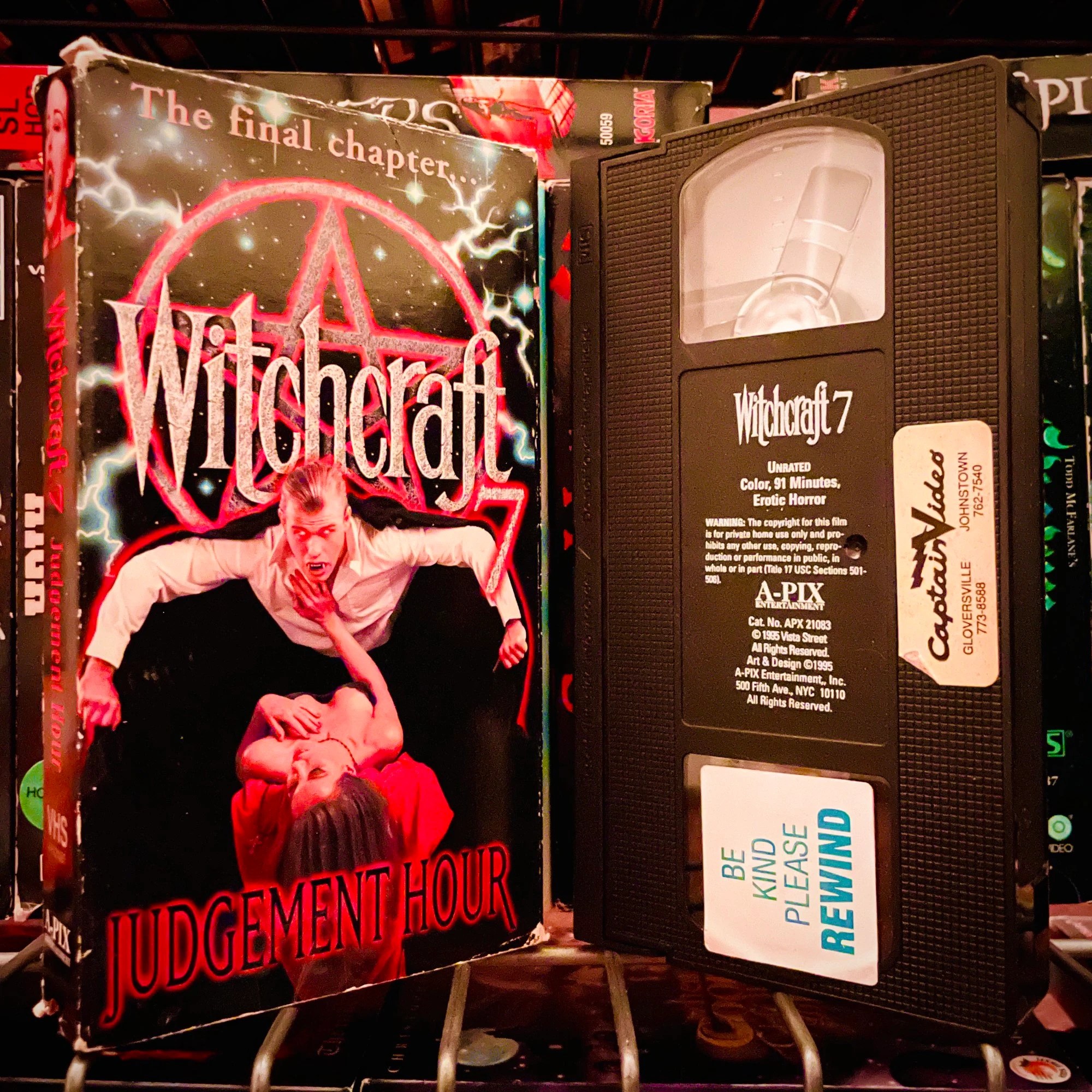
Witchcraft 7: Judgment Hour (1995), the first one to deal with vampires, was originally intended to bring the series to a close, and kills Will off at the end. Despite this, he’s back by Witchcraft 9 just two years later – only he comes back as a ghost that no one can see and only one person can hear, a state which he maintains for almost the film’s entire running time before being inexplicably resurrected at the end.
Combined with the franchise’s erotic elements, this insistence on following the adventures of our “good warlock” helps to position Witchcraft at the vanguard of the urban fantasy movement that was growing in popularity around the same time that these flicks were clogging up video store shelves. Which maybe goes some distance toward explaining the series’ longevity, though it doesn’t seem like quite enough.
“Someone must be invested in the series’ mythology,” writes Katie Rife at the A.V. Club but, if that’s the case, it’s not a writer or a director, all of whom change even more frequently than the actors who play Will Spanner. If the Witchcraft saga was a passion project for anyone, it might have been Jerry Feifer, who passed away in 2025, but only after amassing producer or executive producer credits on pretty much all of the films in the series.
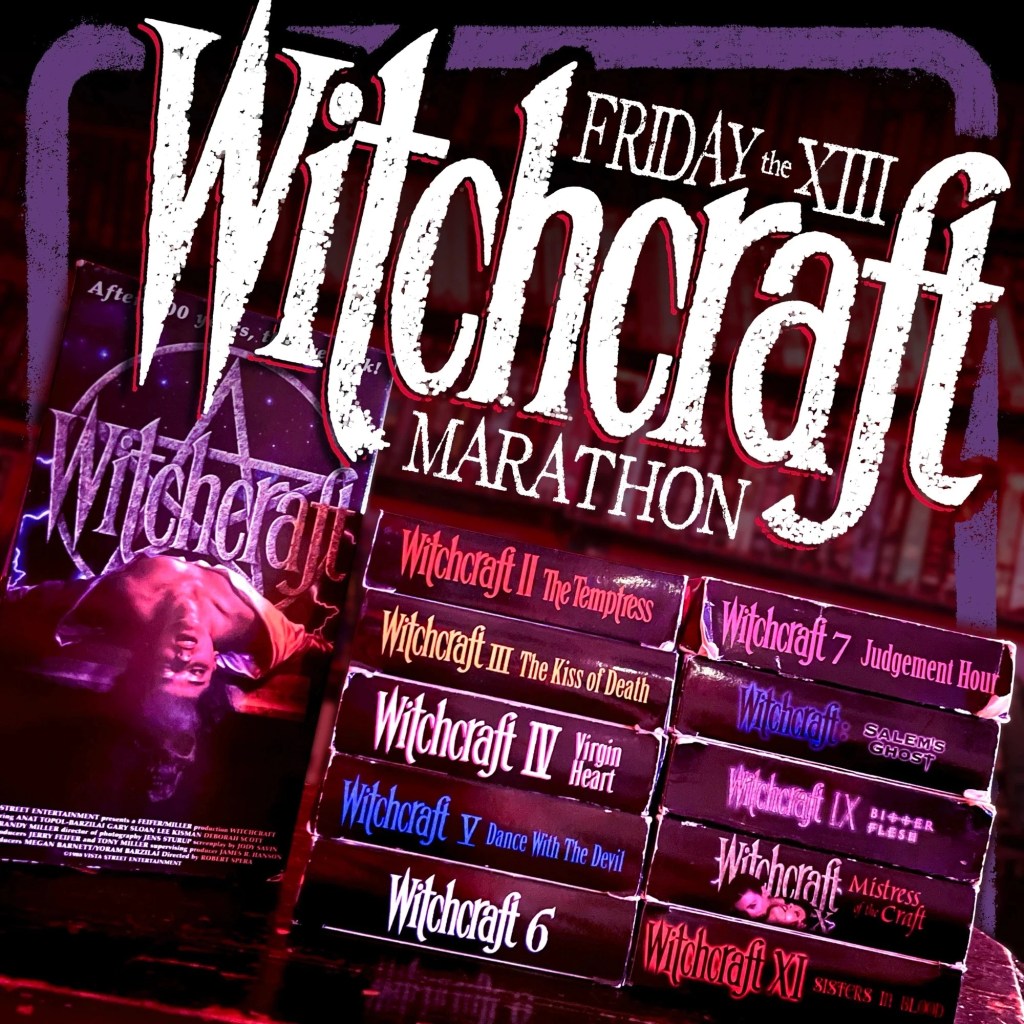
Why am I speculating about this now? On Friday the 13th of March, 2026, I, who had never before seen even one of these innumerable flicks, sat down to watch what turned out to be ten of the first eleven all in one fifteen-hour marathon.
My friend Elijah LaFollette, proprietor of Magnetic Magic Rentals and host of Analog Sunday, had been trying for some time to acquire all eleven of the Witchcraft films that were originally released on VHS. Recently, he finally tracked down the last titles that he had been missing, and the only obvious recourse to celebrate such a milestone was to watch them all in one terrible sitting – leaving aside that he had seen hardly more of them than I had.

Thus, the stage was set. We stocked up on snacks and sodas, and pressed play at 11am, not stopping until two the following morning. Along the way, we ultimately had to skip Witchcraft 8: Salem’s Ghost due to logistical issues. Fortunately, Witchcraft 8 is also “the Halloween III of the series,” as it is the only one to completely abandon Spanner and his cast of recurring characters in favor of a rebooted story that’s shades of soft-core Amityville – or so I’m told, I still haven’t seen it.
There were times, during that soul-searing marathon, when I considered throwing in the towel. The Witchcraft movies are famously not good, and that’s often true. Oddly enough, however, the series isn’t an example of consistently diminishing returns. The better and worse installments jostle for position next to one another, and while nine and ten were among the worst of the bunch, eleven may actually have been one of my favorites.
And say what you want about this series, it’s not every franchise where the eleventh installment is one of the better ones.
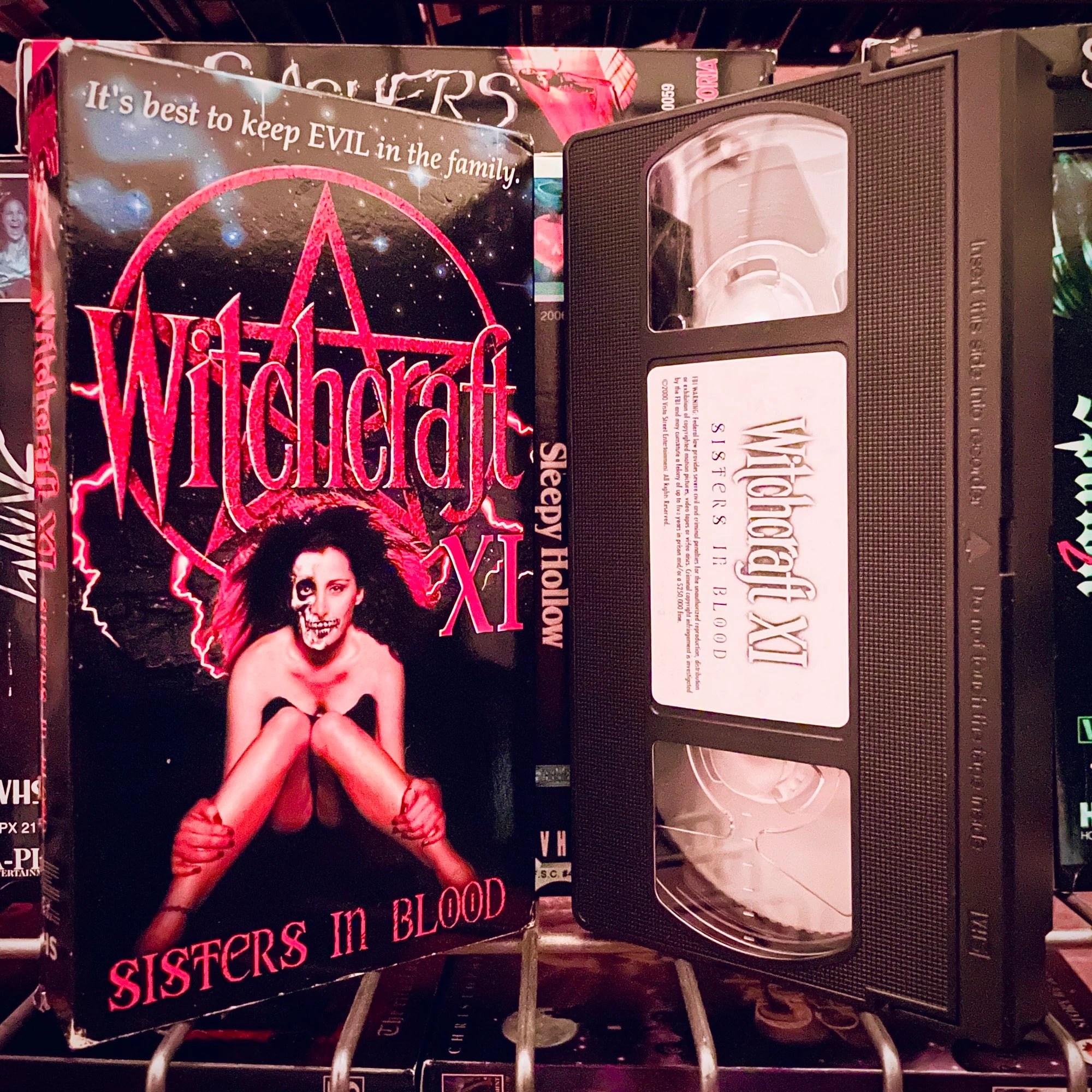
We stopped at eleven because that’s where they initially stopped being released on VHS – but they didn’t stop getting released entirely. 2002’s Witchcraft 12: In the Lair of the Serpent was the first not to get an initial VHS release, but it and several others went direct-to-DVD, sporadically continuing the series through 2016, when a whopping three Witchcraft sequels all came out in the same year.
In 2025, the series saw the release of its seventeenth installment – but maybe not its final one. The cast and crew behind 2025’s Witchcraft 17: The Initiation has announced plans for an eighteenth film, one that they claim will be “the bloodiest, scariest installment the franchise has ever seen.”
It’s also supposed to be found footage.
“It’s hard to fathom why this cheap-looking, uninspired series has run so long,” TV Guide wrote in a review of Witchcraft 6 – and the franchise has obviously run an awfully long time since then. “Perhaps video store buyers and their customers figure that any series with this many installments has to have something going for it. But they’d be wrong.”
[Photos by Elijah LaFollette.]




 The Incredibly Strange Creature Who Stopped Living and Became Orrin Grey
Leave a comment