A thing that has happened to me more than a few times in my life is that I have seen a single still from a movie that has convinced me to add that movie to my watchlist, even when it has often taken years for me to finally track down a copy and actually watch it.
Such was the case with La Main du Diable, a horror film made in Nazi-occupied France by the father of legendary director Jacques Tourneur. Sometimes known as The Devil’s Hand or by the less apropos English moniker Carnival of Sinners.
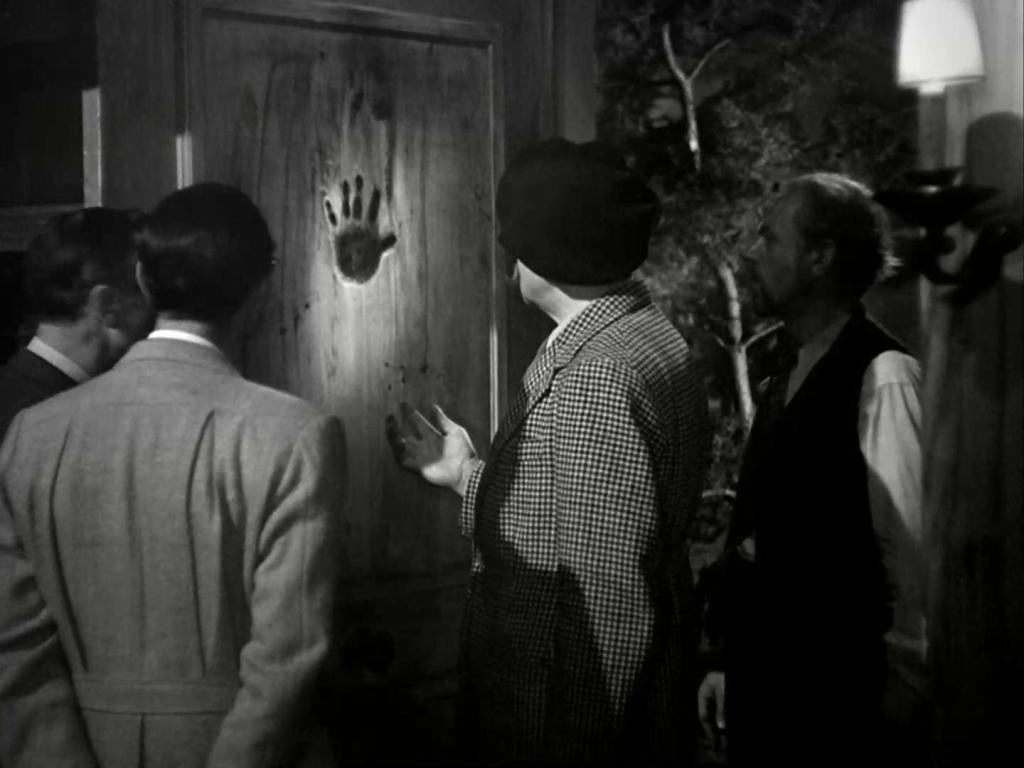
The still in question depicts two men hunched over a table in a rather bare room as a shadowy hand looms over them. It is indicative of the visual delights waiting in La Main du Diable.

Sometimes, when the quest to find a film begins with something so simple as a single image, it can end in disappointment or anticlimax. Not so with The Devil’s Hand. It is wild that, so far this year, I have seen three films, all of them nearly a century old, that are more dynamic, more lively, more visually exciting than just about anything that has been produced so far in the 21st century – and that’s not just my affection for old movies talking.
(The other two, for those who are curious, are Paul Leni’s silent classics The Cat and the Canary and The Last Warning.)
When it comes to the striking shadowplay possible in black-and-white films, Jacques Tourneur was one of the best to ever do it, directing some of my favorite horror movies of all time including Curse of the Demon, Cat People, and I Walked with a Zombie, among others. Watching La Main du Diable, it’s clear that he came by it naturally.

The expressionist films of the early 20th century are known for their long shadows, and they’ve rarely been used as effectively as they are here. These stylistic flourishes are only one of many elements that make La Main du Diable so memorable, however.
While its Faustian tale of a devil’s bargain, adapted from a 1927 novel by Gerard de Nerval, is familiar enough on paper, its elements are endlessly memorable, from the hand itself and the bizarre particulars of its curse to the Devil (credited as “le petit homme”) played to twinkling perfection by Pierre Palau, a performance that feels as much predictive of shows like The Twilight Zone as it is reminiscent of Walter Huston’s potrayal of “Mr. Scratch” in The Devil and Daniel Webster from a few years earlier.
The hand’s latest owner is an artist, and even the on-screen depictions of his art are suitably atmospheric and striking standouts – frequently massive paintings which dominate the screen and provide haunting context for the character interactions taking place in front of them.

The context of the film itself is equally fascinating. While Maurice Tourneur is not as well known in the States as his son, he directed dozens of films (many of them silent) and had worked in Hollywood until he was removed from production of MGM’s version of Jules Verne’s The Mysterious Island in 1928, “over his painstaking commitment to the beauty of the shot.”
Despite this, father and son Tourneurs were actually making movies contemporaneously by 1943, and the same year that La Main du Diable hit screens also saw the release of Jacques Tourneur’s second and third films for Val Lewton and RKO. Indeed, the junior Tourneur’s classic I Walked with a Zombie actually released on the same day in New York that The Devil’s Hand premiered in France – April 21, 1943.

More striking than this familial synchronicity, however, is the fact that La Main du Diable was made and released in Nazi-occupied France, by the Reich-controlled Continental Films. Of course, the Faust story was already an old one in 1943, and there have been countless be-careful-what-you-wish-for, deal-with-the-devil movies over the years. But given the material conditions under which La Main du Diable was made, its almost impossible to read its particular iteration of the fable as anything less than a cautionary tale against the dangers of collaboration. When you achieve what you desire with the help of the devil, the price will always be higher than you are able to pay.






 The Incredibly Strange Creature Who Stopped Living and Became Orrin Grey
Leave a reply to Orrin Grey Cancel reply