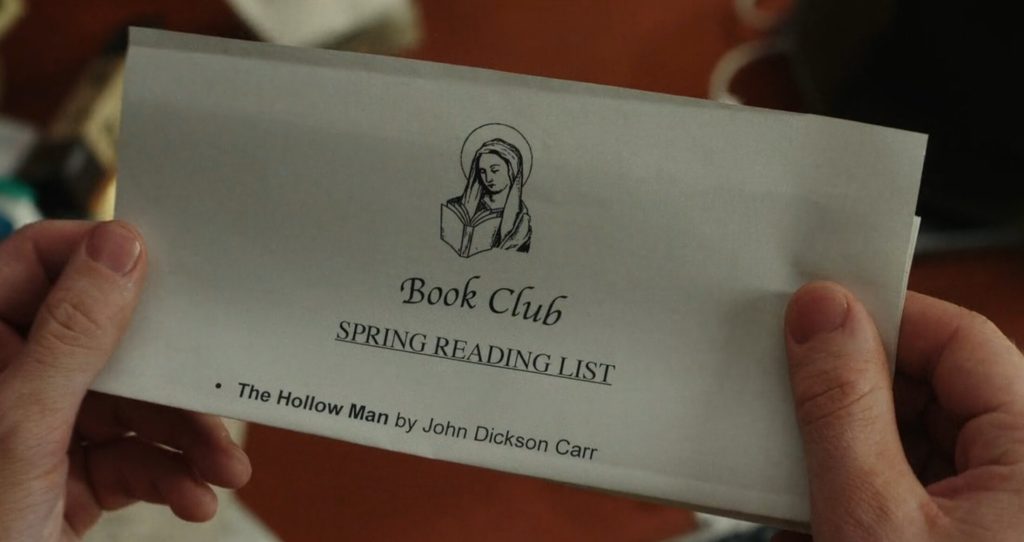
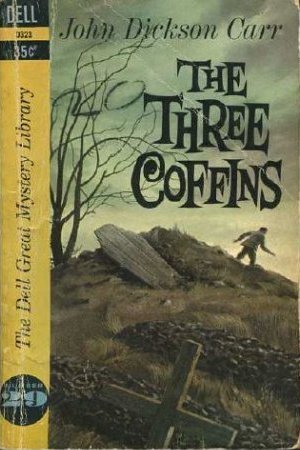
Wake Up Dead Man was one of the best new movies that I saw last year – not an especially difficult proposition, given the relative paucity of movies I saw that came out last year. It was also one of those movies that uses another piece of media as a major prop in its plot, in this case a 1935 novel by John Dickson Carr called either The Three Coffin (in the States) or The Hollow Man (in the UK, though Wake Up Dead Man uses the seemingly more popular UK title, despite being set in New York State).
Not only does the movie mention the novel several times, it even takes a break to reproduce, more or less, the book’s famous “Locked Room Lecture,” a chapter in which series protagonist Dr. Gideon Fell functionally breaks the fourth wall by telling police inspector Hadley (another recurring character) that “we’re in a detective story, and we don’t fool the reader by pretending we’re not.”
From there, Dr. Fell outlines many of the “rules” and methods of the locked room mystery. It’s a wonderful chapter in a wonderful book, blustery and dynamic, eerie and vivid. Prior to seeing Wake Up Dead Man, I had never read it, but the movie convinced me to put a hold at the library. Apparently, I wasn’t alone, as I placed the hold all the way back in November when I saw the film, and the book only lately arrived.
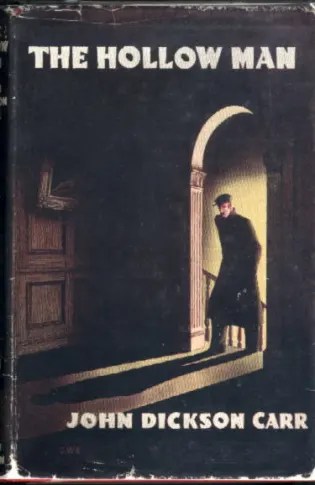
I wasn’t wholly unfamiliar, either with John Dickson Carr – one of the only American writers to be inducted into England’s legendary Detection Club, where he could have rubbed elbows with the likes of Agatha Christie, Dorothy L. Sayers, Hugh Walpole, Baroness Orczy, and so on – or with The Hollow Man.
I had read a couple of novels by Carr and enjoyed both, though neither enough to necessarily seek more out nor proseletyze on their behalf. At least one (The Corpse in the Waxworks, 1932) I read almost solely because it involved a wax museum. And I knew the reputation of The Hollow Man. I had heard of the oft-reprinted “Locked Room Lecture,” though I hadn’t read it, and I knew that the novel had been adjudged by a group of experts (in this case, 17 other mystery writers, and who am I to gainsay their authority in this matter) as the greatest locked room mystery of all time.
None of which prepared me for how good it actually is. “Holy hell, they weren’t kidding about John Dickson Carr’s The Three Coffins / The Hollow Man,” I wrote on social media, immediately after finishing the novel. “This thing’s a barn burner!”
And it really is. While the “Locked Room Lecture” is justly famous, it is only one of many pleasures to be found within these pages, and the novel is propulsive, atmospheric, and unfailingly unique, even from the first few sentences.
Despite how many paragraphs I’ve spent doing just that, however, I’m not really here to sing the praises of a highly celebrated book that’s already almost a century old. Rather, I wanted to write a bit about one particular section.
Well before we get to the lauded “Locked Room Lecture,” Dr. Fell delivers another, equally verbose diatribe – this time about his preferences re: the ghost story. And being that I am someone who trucks with ghosts more than murderers, and who likes things a bit old-fashioned, I found myself even more tickled by it than by the later, more famous lecture.
The spiel being somewhat shorter than its more famous cousin, I’ll reproduce the majority of it here. It begins when another character (named Pettis) tells Dr. Fell, “I don’t entirely agree with you (or Dr. James) that a ghost in a story should always be malignant…”
“Of course it should always be malignant. The more malignant,” thundered Dr. Fell, screwing his own face up into a tolerably hideous leer, “then the better. I want no sighing of gentle airs around my couch. I want no sweet whispers o’er Eden. I want blood!” He looked at Pettis in a way which seemed to give the latter an uncomfortable idea that it was his blood. “Harrumph. Ha. I will give you rules, sir. The ghost should be malignant. It should never speak. It should never be transparent, but solid. It should never hold the stage for long, but appear in brief vivid flashes like the poking of a face round a corner. It should never appear in too much light. It should have an old, an academic or ecclesiastical background; a flavour of cloisters or Latin manuscripts.”
Pettis and Dr. Fell go on to dispute a bit about whether ghosts should show up in modern places or, Dr. Fell’s position, predominantly in old libraries and ancient ruins, at the end of which Pettis asks, “Don’t you believe that ghood ghost stories can be written nowadays?”
“Of course they can be written nowadays, and there are more brilliant people to write ’em… if they would. The point is, they are afraid of the thing called Melodrama. So, if they can’t eliminate the melodrama, they try to hide it by writing in such an oblique, upside-down way that nobody under heaven can understand what they are talking about. Instead of saying flat out what the character saw or heard, they try to give Impressions. It’s as though a butler, in announcing guests at a ball, were to throw open the drawing-room doors and cry: ‘Flicker of a top-hat, vacantly seen, or is it my complex fixed on the umbrella stand faintly gleaming?’ Now, his employer might not find this satisfactory. He might want to know who in blaxes was calling on him. Terror ceases to be terror if it has to be worked out like an algebra problem. It may be deplorable if a man is told a joke on Saturday night and suddenly bursts out laughing in church the next morning. but it is much more deplorable if a man reads a terrifying ghost story on Saturday night, and two weeks later snapes his fingers and realizes that he ought to have been scared.”
Now, naturally, I don’t necessarily agree with everything Fell says here. I doubt that many do – probably, given the character’s disposition, not even Fell himself – but I found it a lot of fun to read, and I found elements of it ringing just as true in this age when we have arguments about “Elevated Horror” as it probably did when Carr was writing it a century ago.






Leave a Reply